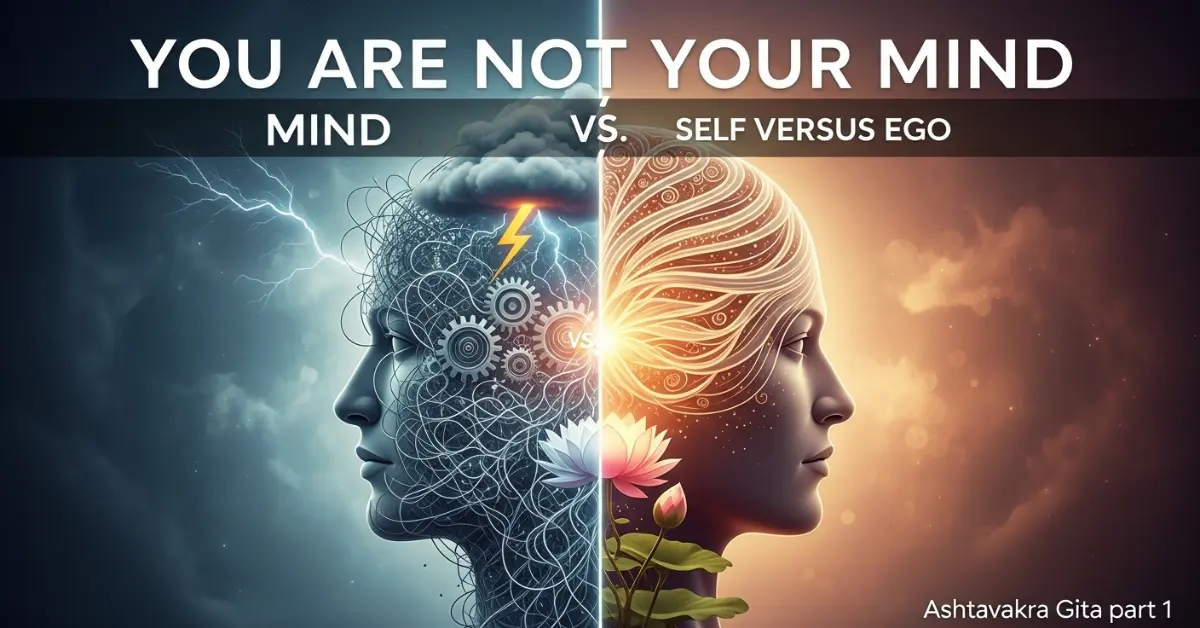
Let’s get right to it: you’ve been conducting the largest deception on yourself by believing you’re your thoughts. Think about it. Most of us get up every day and let our thoughts lead us around like a puppy following its owner. One minute your brain is repeating that awkward thing you said five years ago, and the next it is imagining worst-case scenarios for the future. And you? You simply follow along, as if every random thought were gospel truth. But the Ashtavakra Gita does not believe it. Its first blow to the belly is straightforward but radical: you are not your body. You aren’t your mind. You are the consciousness that observes both.
The Conversation: Janaka meets Ashtavakra.
Here’s one of the most significant discussions right from the start of the text (verses 1.3-1.4, simplified): Janaka asks, “How can knowledge be gained?” How can liberation be achieved? How can separation be achieved? “Tell me, master.” Ashtavakra advises avoiding sense objects and focusing on forgiveness, truthfulness, kindness, contentment, and truth to achieve emancipation. You are neither earth, water, fire, air, or space. You are not this body or mind. You are pure consciousness, the witness of everything. “Be cheerful.
Breaking It Down
Take notice of the vibe here. Janaka is like you and me: sitting there, full of questions, entangled in the mess of life. “How do I get out of this mess? “How can I find peace?” And Ashtavakra? He does not provide a ten-step plan. He doesn’t say, “Do this ritual” or “Chant this mantra.” He simply cuts through the noise: 1. Stop identifying with the external circus (sensory objects). 2. Remember who you truly are – not your body or mind, but awareness itself. 3. Relax – happiness is in your nature, not something you can acquire. It’s like telling a drowning man, “Bro, you’re sitting in a shallow pool.” “Stand up. If you give it time, it’s direct, simple, and world-changing.
Self vs. Mind: A Netflix Example
To convey this to a modern reader, consider Netflix. When you’re engrossed in a thriller, you feel everything: dread, suspense, and heartache. For a little period, you forget you’re looking at pixels on a screen. That is exactly how we become caught in our imaginations. We confuse the movie (thoughts, emotions, ego-drama) for reality, forgetting that we are the ones sitting on the couch watching. Ashtavakra’s advice? Stop confuse yourself with the film. You aren’t the narrative twists. You are not the actors. You are the quiet consciousness, the “screen” on which everything plays out.
Why This Teaching Matters (Especially Now)
Here’s the part that will touch home in 2025: our culture values the mind. Hustle culture? It praises an endless mental grind. Social media? It’s basically all ego cosplay all the time. Even therapeutic culture can over-identify with the story: “my trauma, narrative, and identity.” I’m not suggesting those things are pointless – because they all happen in the head. And the mind doesn’t stop. It’s like having a roommate who refuses to shut up, and you believe you are that roommate. The Ashtavakra Gita is when you realize: Wait. I am not the roommate. I’m the one listening to the noise. That is freedom.
What Does This Look Like in Real Life?
So, how can you live this teaching without retreating to a cave? 1. Observe the Narrator. Next time your mind spirals (“I’m such a failure” / “What if I never make it”), pause and ask: Who is observing this thought? The awareness Ashtavakra refers to is the space between “you” and “the thought”. 2. Separate Pain from Suffering. Breakups, layoffs, and losses are unavoidable in life. That is real. What about the suffering? That’s the mind rehearsing it on repeat, creating scenarios like “I’ll never recover.” Awareness perceives pain without becoming engulfed in mental drama.3. Practice micro-pauses. Pause for two seconds before reacting — sending an angry email, doom-scrolling, or overeating. Take note that the thought is not the same as the action. That pause contains your freedom.
The Ego Freaks Out
Here’s the catch: when you start doing this, your ego will scream. It’ll panic: “If I’m not my thoughts, then who am I?” “If I stop believing my mind, won’t I lose control?” “It’s bizarre. “Let’s just binge watch Netflix and forget about philosophy.” That is normal. The ego resents being dethroned. But you don’t have to kill it. Simply stop handing it the car keys. Allow it to communicate in the backseat while you drive attentively.
Return to Janaka and Ashtavakra.
Here is the beauty of the ancient dialogue: Janaka begins desperate—like us, he believes that liberation is about fixing the mind, the world, and himself. But Ashtavakra basically implies that freedom is not something you earn. It is something you remember. Janaka feels compelled to take action. Ashtavakra believes he needs to quit confusing himself for someone he is not. That’s why the Gita is still relevant thousands of years later. The human mentality has not changed. The trap remains unchanged, as does the escape route.
The first lesson of the Ashtavakra Gita is a paradox: what you thought you were – your mind, your thoughts, your tale — is not who you are. And, yes, that is both terrible and empowering. It’s terrifying because it exposes your true identity. Liberating because it means you can finally be free of every thought, worry, and ego demand. So the issue Ashtavakra leaves hanging in the air is the same one you must confront today: If you are not your mind, who are you?
That isn’t a question to speed through. That’s the invitation. And the instant you start living that question, you’re already on the path to freedom.