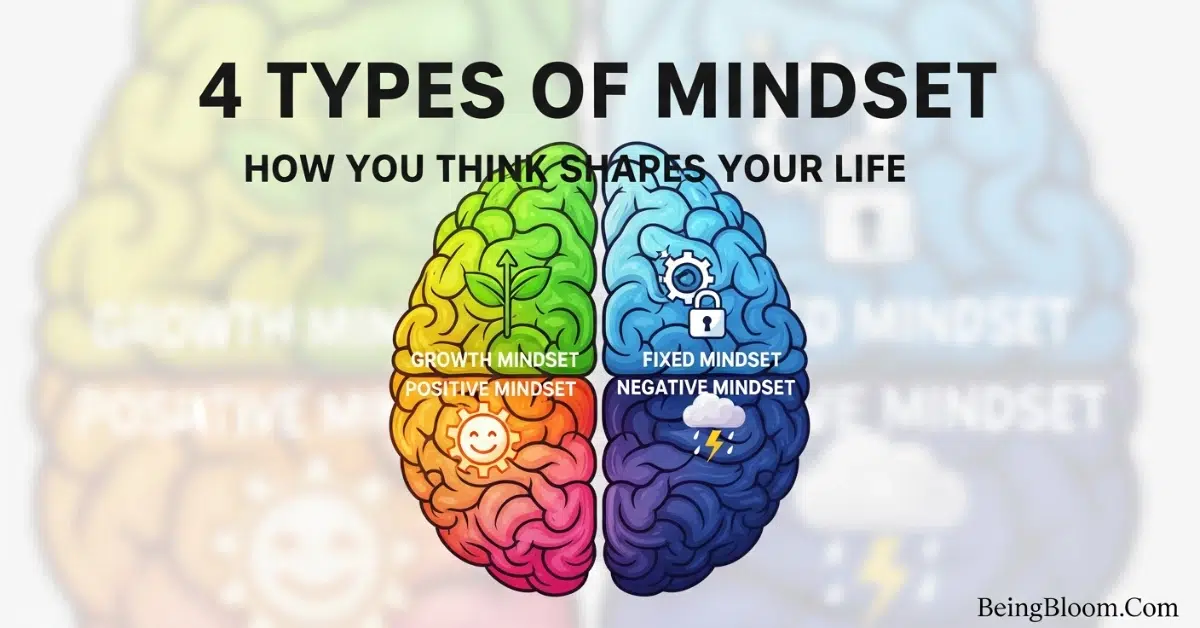
Your surroundings do not shape your life exclusively. It is shaped by how your mind perceives those conditions. Two persons can experience the same failure; one develops stronger while the other gives up. The difference is not due to IQ, luck, or talent. It’s a mindset. Mindset is the mental lens through which you perceive the world, yourself, and your abilities. Over time, psychologists and intellectuals have discovered patterns in how people think. These patterns can be broadly classified into four categories of mindsets. You could recognize yourself in more than one. Most people transition between them without recognizing it. Let us break them down—honestly, practically, and without motivational fluff.
The Fixed Mindset
A fixed mindset holds that abilities, intelligence, and personality qualities are set in stone. This thinking leads to the assumption that “this is just how I am.” They take their failures personally. Failure feels more like a verdict than input. As a result, they avoid difficult situations, fight change, and are afraid of being revealed as “not good enough.” This worldview frequently appears logical, but it is emotionally weak. It supports self-esteem in the near term but stifles growth in the long run. The fixed mindset relies on labels like smart, foolish, gifted, and untalented. When the label sticks, any attempt seems worthless. The tragedy isn’t a lack of skill. It is an unwillingness to test what is conceivable.
The Growth Mindset
The growth mentality holds that abilities may be developed through effort, study, and perseverance. This worldview does not romanticize struggle, but rather respects it. Challenges are viewed as training grounds, not threats. Failure becomes information, not an identity. People with a developing mentality nonetheless experience anxiety and doubt. The difference is that they do not let their emotions to dictate their decisions. This attitude raises better questions like “What can I learn from this?”. “How can I improve next time?” Growth attitude should not imply mindless optimism. It denotes realistic confidence—the feeling that development is achievable with the appropriate approach. This is the mindset that drives mastery, resilience, and long-term success.
The scarcity mindset
The scarcity perspective holds that there is never enough—time, money, love, achievement, or opportunity. Life feels like a competition in which someone else wins and you lose. Comparison becomes a constant. Anxiety becomes usual. People experiencing scarcity frequently overwork, overthink, and overreact. They want recognition, hoard resources, and are afraid to let go. This thinking keeps you occupied but not satisfied. You’re always running and rarely arriving. Scarcity limits perception. When the mind is threatened, creativity decreases and survival mode takes over. Decisions become reactive rather than planned. Ironically, scarcity thinking frequently results in the very shortage it fears.
The Abundance Mindset
The abundance perspective holds that growth, opportunities, and purpose are malleable—not fixed. This does not imply ignoring reality or pretending resources are unlimited. It entails realizing that value is frequently created rather than competed for. People that hold this perspective collaborate rather than compete blindly. They celebrate other people’s accomplishments without feeling reduced. They prioritize learning, connections, and long-term vision. Abundance fosters calm confidence. You stop chasing everything since you’re no longer concerned about missing out. This approach allows for generosity, patience, and clarity. It switches the emphasis from “What can I get?” to “What can I build?”. Abundance is not about having more. It’s about requiring less to be complete.
How These Mindsets Shape Our Daily Lives
Mindset silently determines how you react to criticism, deal with stress, and make decisions. A fixed attitude avoids feedback. A growth mindset wants it. A scarcity mindset persists. An abundance mindset is based on trust. None of these attitudes constitute lasting identities. They are patterns—learned, reinforced, and adaptable. You may have a progressive attitude at business, but a fixed perspective in relationships. You may feel emotionally affluent but financially limited. Awareness is the tipping moment.
Change Your Mindset Without Forcing Positivity
Repeating affirmations does not improve one’s thinking. You can adjust it by observing your own reactions. Consider what you tell yourself when things go wrong. Consider how you respond to others’ success. Consider how fear influences your decisions. Replace judgment with curiosity. Replace avoidance with small-scale experiments. Replace comparison with self-reflection. Mindset adjustments are incremental, not sudden.
The Bigger Truth
Your mindset has an impact on more than simply your cognitive abilities. It influences what you think is feasible. What you feel is feasible impacts how you live, whether proudly or cautiously. You don’t have to become someone else. You need to see things differently. Change the lens, and the world changes along with it.