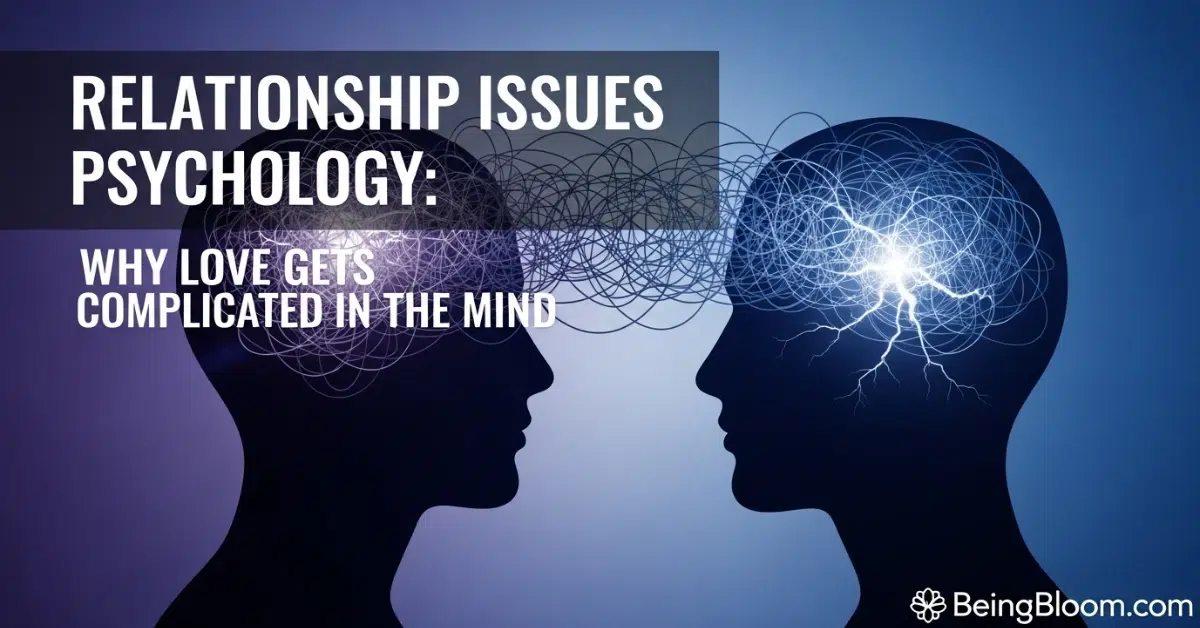
Most relationship troubles do not begin with a major argument. They start gently, in the mind. Two people can care deeply about each other yet also feeling misunderstood, distant, or fatigued. Relationships are psychological systems formed by past experiences, unmet wants, fears, and expectations. Understanding the psychology of relationship challenges does not render love mechanical. It makes everything clearer.
Emotional baggage enters all relationships.
No one starts a relationship as a blank slate. We bring up childhood programming, past heartbreaks, family relationships, and unspoken love norms. Emotional events are difficult for the brain to forget. It keeps them as protective strategies. If a person learns early on that love is unstable, their mind is always on the lookout for danger, even when there is none. If affection was formerly associated with control or neglect, intimacy can now cause anxiety rather than comfort. These reactions appear personal, although they are frequently the result of previous emotional memories being replayed in new contexts.
Attachment styles influence how we love.
According to psychology, people form attachment patterns early in life, which shape their later relationships. Some people want connection but are afraid of being abandoned. Some people value freedom and feel smothered by emotional intensity. Some people feel safe and comfortable with intimacy. Problems develop when partners misinterpret each other’s conduct as rejection, control, or a lack of concern—when it is actually a coping strategy learned long ago. Attachment issues do not indicate that someone is broken. They mean that their nervous system developed a special technique to withstand connection.
Communication breakdowns rarely include words.
The majority of arguments do not revolve around what is being stated. They are about what people feel but do not express. One person perceives criticism where the other intended to express concern. Another interprets silence as disinterest, while it was clearly an emotional shutdown. Psychologically, when people feel threatened, their brain prioritizes defense over comprehension. Listening gets difficult. Assumptions close the gaps. Healthy communication necessitates emotional safety, not precise words.
The Role of Expectations and Fantasy.
Many marital troubles stem from unreasonable expectations. Movies, social media, and cultural narratives all promote the sense that love should be effortless, passionate, and endlessly rewarding. Psychology reveals a different story. When reality does not match the fantasy, disappointment increases. Partners begin to blame each other for sentiments that stem from failed expectations, rather than genuine mistreatment. Love is not meant to fulfill you. It is meant to meet you where you are.
Fear of abandonment and fear of intimacy.
These two anxieties frequently coexist. Some people fear being abandoned, so they cling. Others are afraid of being eaten, so they pull away. The more one pursues, the more the other flees. Psychologically, this creates a cycle in which both partners feel insecure, despite their desire to connect. Without understanding, partnerships become emotional tug-of-war rather than mutual support.
Conflict is not the real problem.
Conflict is normal. The damage comes from avoiding it. Psychology demonstrates that suppressed emotions do not disappear. They manifest as sarcasm, remoteness, subtle anger, or unexpected outbursts. Healthy connections tolerate discomfort. They tolerate disagreement without making it a threat. It is not about winning arguments. It’s about being emotionally present during them.
Self-worth and Relationship Issues
Relationships become weak when a partner’s approval determines one’s self-esteem. Jealousy, insecurity, and overthinking are typically caused by an internal belief: “If they change, I lose my value.” Psychology emphasizes that relationships thrive when two entire people connect, not when one person serves as the emotional anchor for the other. Your partner can help you. They cannot replace your feeling of self.
How Awareness Alters Relationships
Understanding relationship psychology does not immediately solve problems. However, it transforms guilt into insight. Instead of saying, “What’s wrong with them?” You start wondering, “What’s triggering me?” Rather than reacting, you pause. You clarify rather than make assumptions. This knowledge creates space—space for responding rather than reacting.
The Core Lesson
The majority of relationship troubles are not due to a lack of love. They result from unexamined patterns. When you grasp the psychology of conduct, relationships stop seeming like emotional minefields and instead feel like possibilities for progress. Love becomes less about repairing each other and more about seeing how two inner worlds intersect. And that understanding is when true connection begins.