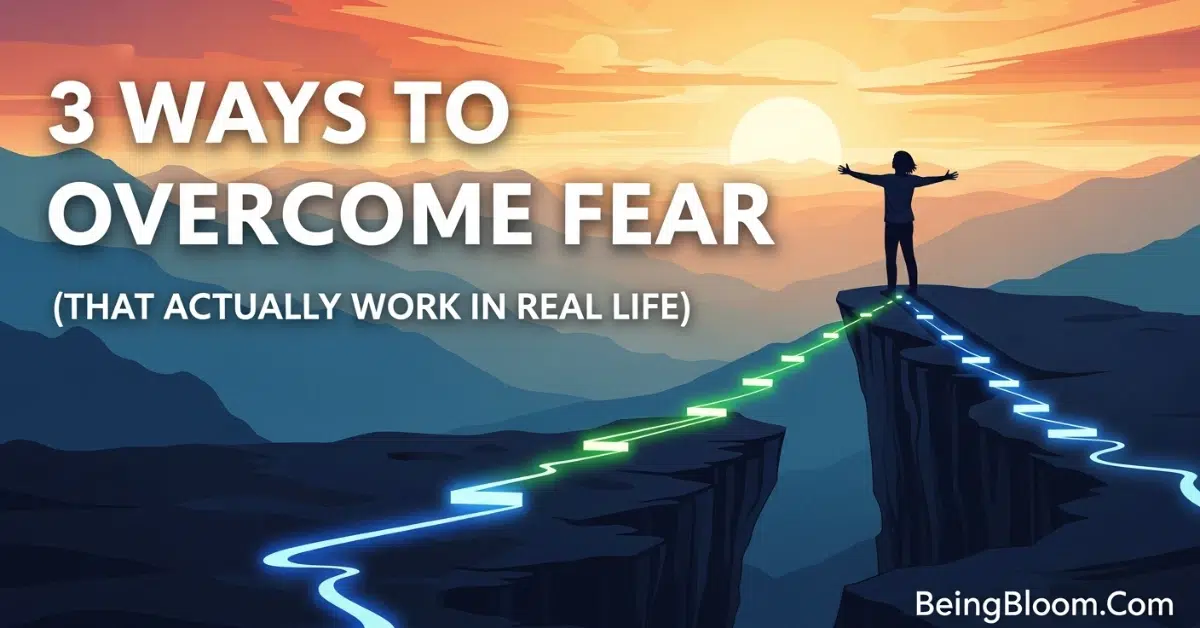
Fear is not uncommon. It appears when you desire to change, speak up, take a chance, or simply be truthful. It does not always scream. It sometimes whispers and silently directs your decisions. Most people attempt to overcome fear. That’s why it keeps returning. The goal isn’t to eliminate fear. The goal is to break free from its control. Here are three practical approaches.
1. Stop seeing fear as a problem.
Fear gains power when you declare it shouldn’t exist. You tell yourself, “I need to get rid of this fear before I act.” That worldview grants fear authority. Now, fear determines when you are allowed to live. Fear is a natural response to uncertainty. It does not imply danger; rather, it refers to new land. When you allow fear to exist without stressing about it, something unusual happens: it lessens. Not immediately, but progressively. Fear thrives on resistance. Acceptance depletes it. You do not overcome fear by eliminating it. You overcome fear by pushing forward when it is present.
2. Shift focus from outcome to action.
The majority of fear stems from the unknown future. Fear of failure. Fear of being rejected. Fear of losing control. All of them are about outcomes that you cannot completely control. The mind panics because it seeks clarity in an unpredictable reality. The remedy is action-oriented attention. Instead than asking, “What happens if this goes wrong?” inquire; “What is the next honest action I can take?” When the focus shifts to the present step—one phone call, one talk, one decision—fear loses grip. The body relaxes when it has something substantial to accomplish. Fear survives in the imagination. Courage is built via action.
3. Create Internal Safety, Not External Protection
Many people attempt to conquer fear by controlling their surroundings. They avoid certain situations, persons, and hazards. Life shrinks, but fear does not disappear; it simply relocates. True fearlessness stems from inner safety. Inner safety is recognizing one’s ability to cope with discomfort. “I can survive failure.” “I can sit with uncertainty.” This confidence does not stem from success. It comes from confronting fear repeatedly and understanding it did not destroy you. The heart grows strong not because nothing hurts, but because it knows it can withstand.
Most people dislike hearing the truth.
Fear does not disappear permanently. It fades, returns, changes shape, and appears at new degrees of development. If fear is entirely eliminated, growth also ceases. Fear does not indicate that you are living your life incorrectly. It’s frequently an indication that you’re doing something worthwhile. The question is not, “How do I get rid of my fear?” The actual question is, “Will I let fear decide my life?”Overcoming fear does not mean being fearless. It is about becoming free enough to act in the face of fear, honest enough to confront it, and grounded enough not to succumb to it. Fear may knock. You do not have to let it drive. And it is through repeated choices that fear gradually loses its power.